
Tech Trends
ERP Explained Simply: What Actually Happens When Your Business Systems Talk to Each Other?
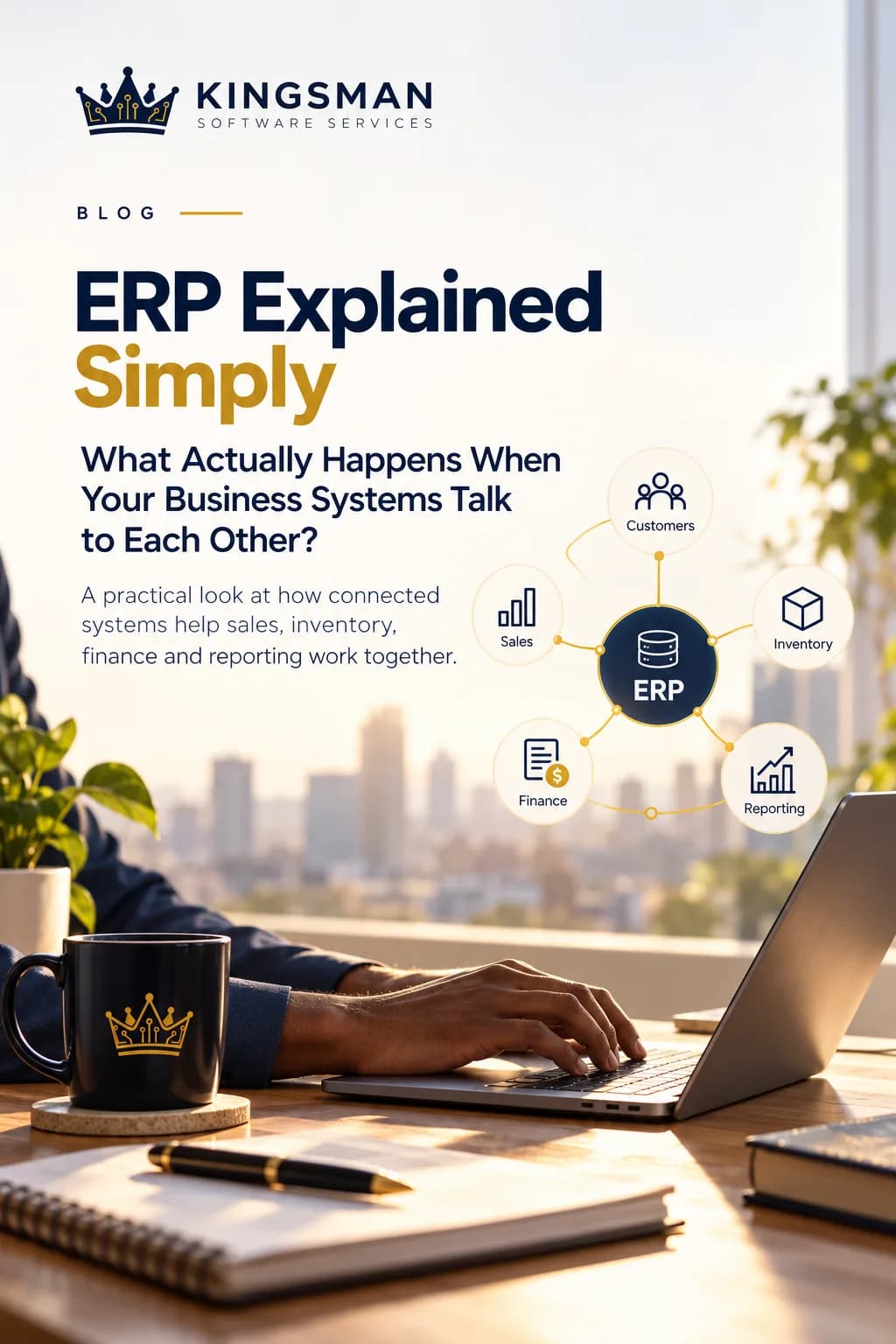
Imagine a customer buys a product from your business.
The salesperson records the sale. Someone in the warehouse updates stock. Finance records the payment. Another employee updates the customer's account. At the end of the day, management needs a report showing what was sold, what is still in stock and how much money came in.
In many businesses, these activities happen in different systems, spreadsheets or even WhatsApp conversations.
The information eventually reaches the right people, but often after repeated data entry, phone calls, messages and reconciliation.
An Enterprise Resource Planning system, commonly known as ERP, is designed to change that.
At its simplest, ERP helps different parts of a business work from connected information instead of operating as separate islands.
What Does an ERP System Actually Do?
ERP may sound like a complicated technical concept, but the basic idea is straightforward.
Think about the main areas of a business:
Sales
Inventory
Finance
Purchasing
Customer management
Human resources
Operations

Without integration, each department may maintain its own records.
Sales knows what customers ordered.
The warehouse knows what stock is available.
Finance knows which invoices have been paid.
Management then has to bring all that information together to understand what is happening across the organisation.
An ERP system connects these processes.
Instead of departments constantly passing information between one another manually, the system allows relevant information to move automatically.
The goal is not simply to put everything into one piece of software.
The real goal is to create one connected flow of business information.
What Happens When the Systems Start Talking?
Consider a simple example.
A customer purchases ten units of a product.
In a connected system, recording that transaction can trigger several actions.
The sales record is created.
Inventory is reduced by ten units.
The customer's transaction history is updated.
Finance receives the information required for the invoice or payment record.
Management reports reflect the new sale.
If stock has reached a predefined minimum level, the purchasing team can also be alerted that more stock may need to be ordered.
One business event has updated several parts of the organisation.
Nobody needs to take information from the sales system and manually type it into four other places.
That is one of the most important ideas behind ERP.
One Version of the Truth
Consider another situation.
The sales department believes there are 30 units of a product available.
The warehouse spreadsheet says 24.
The accounting records show that 27 have already been sold.
Management's weekly report says 35.
Which figure is correct?
This becomes increasingly difficult as a business grows.
A connected system creates what is often called a single source of truth.
Rather than different departments keeping separate versions of the same information, authorised users work from shared and synchronised business data.
It does not mean every employee can see everything.
Finance may have access to financial information that warehouse employees do not need. Management may have access to reports that other employees cannot view.
The difference is that the information comes from a connected system rather than several disconnected records.
ERP Is More Than Accounting Software
One common misunderstanding is that ERP is simply another name for accounting software.
Accounting is an important part of an ERP system, but ERP goes much further.
A well-designed system can connect activities such as:
Sales → Inventory → Purchasing → Finance → Reporting
For example, imagine a company receives a large order.
The system can check available inventory.
If there is insufficient stock, purchasing can see what needs to be ordered.
When the goods arrive, inventory is updated.
Once the customer's order is fulfilled, finance receives the necessary transaction information.
Management can then see the effect of the transaction through reports and dashboards.
Instead of employees becoming the connection between systems, the software becomes the connection.
What Is Happening Behind the Scenes?
This is where the technology becomes interesting.
Business systems can communicate in several ways.
Sometimes different departments operate inside the same ERP platform and share a common database.
In other environments, the company may already have different applications that need to remain in place.
For example:
an e-commerce website
a mobile application
an accounting platform
a payment gateway
a CRM
a warehouse system
These systems can communicate through APIs and integrations.
An API essentially provides a controlled way for one software system to exchange information with another.
A customer might place an order through a website, for example.
The website sends the order to the business-management system.
The system updates inventory.
Payment information arrives from the payment provider.
The customer receives confirmation.
Management sees the transaction on a dashboard.
Several systems may have participated in that process, but to the customer it feels like a single experience.
What Happens When Something Goes Wrong?
Connecting systems also introduces an important engineering challenge.
What happens if the payment succeeds but the inventory system temporarily cannot be reached?
What happens if a branch loses internet connectivity while processing transactions?
What happens if the same message is accidentally submitted twice?
Good business software has to account for situations like these.
Behind a simple user interface, developers may need mechanisms for:
retries
transaction tracking
duplicate prevention
data synchronisation
audit logs
backups
access control
conflict resolution
These concepts are especially important when different services, branches or devices need to exchange information.
The user should not need to understand all of this.
They simply expect the system to work reliably.
But reliability is rarely accidental. It comes from good system design.
Does Every Business Need a Huge ERP System?
No.
And this is important.
A ten-person company does not necessarily need the same system as an organisation operating dozens of branches.
Introducing unnecessary complexity can create just as many problems as having inadequate software.
The right question is not:
“Do we need ERP?”
A better question is:
“Where is information breaking down in our business?”
Perhaps inventory and sales are disconnected.
Perhaps employees repeatedly enter the same information.
Perhaps management cannot access reliable reports without combining several spreadsheets.
Perhaps customer information is scattered across phones, emails and spreadsheets.
Perhaps accounting software works perfectly well but needs to communicate with another system.
In some cases, implementing an existing ERP platform is the right solution.
In others, integrating the systems already being used may make more sense.
And sometimes a custom-built business system is the better approach.
Technology should fit the problem rather than the other way around.
The Biggest Benefit Is Not the Software
The real benefit of ERP is not having another dashboard.
It is what happens when information begins to move through the organisation properly.
Employees spend less time copying data.
Departments have better visibility.
Management receives information faster.
Mistakes caused by duplicated records can be reduced.
Customers receive quicker responses.
And as the business grows, its processes become easier to scale.
A good ERP implementation therefore begins with understanding how the business actually works.
Only then should technology enter the conversation.
Connected Businesses Make Better Decisions
Businesses generate information every day.
Every sale, payment, stock movement, customer enquiry and purchase tells part of the story of what is happening inside the organisation.
When those pieces of information remain trapped in separate systems, understanding the full picture becomes difficult.
ERP brings those pieces together.
And when business systems can communicate reliably, technology stops being a collection of separate tools and starts becoming part of how the organisation operates.
At Kingsman Software Services, we believe business software should make operations simpler, not more complicated.
Whether that means implementing an ERP platform, integrating existing systems or developing a solution around a company's specific processes, the objective should remain the same:
Connect the right information, to the right people, at the right time.

Comments
No comments yet. Questions and experiences are welcome.
Leave a comment