
Tech Trends
Why Zimbabwean Businesses Need Software Built for Their Reality

Digital transformation is no longer something reserved for large multinational companies. Businesses of every size are increasingly relying on software to manage customers, payments, employees, inventory, communication, reporting, and day-to-day operations.
But there is an important question that is often overlooked:
Was the software actually designed for the environment in which the business operates?
For many Zimbabwean organisations, adopting technology is not simply a matter of choosing the most popular international platform. Local businesses operate within a unique combination of infrastructure, financial systems, connectivity conditions, regulatory requirements, customer behaviour, and operational realities.
Software that ignores these realities can quickly become expensive, frustrating, or unsuitable.
At Kingsman Software Services, we believe technology should adapt to the business — not force the business to adapt to the technology.
The Problem With One-Size-Fits-All Software
Many global software platforms are built around assumptions that may not always reflect the realities of businesses operating in Zimbabwe.
They may assume:
reliable internet connectivity at all times
international payment methods are readily available
every employee has access to a desktop computer
businesses can comfortably pay recurring foreign-currency subscriptions
integrations with international banking and payment systems are sufficient
operational processes are similar across every market
In practice, businesses often need much more flexibility.
A retail business may need support for local payment methods.
A field organisation may require an application that continues working when connectivity disappears.
A growing SME may need enterprise-level capabilities without enterprise-level licensing costs.
A company operating across several locations may need its systems to synchronise data reliably even when some locations temporarily lose connectivity.
These are not unusual edge cases.
They are real operational requirements.
Local Software Should Understand Local Payments
Payments are one of the clearest examples of why localisation matters.
Zimbabwean businesses may need to support combinations of:
cash
bank transfers
card payments
mobile money
local payment gateways
USD transactions
ZiG transactions
multiple currencies within the same organisation
A system designed around only one payment model can quickly create additional manual work for staff.
Well-designed software should integrate with the payment methods customers already use rather than forcing businesses to restructure their operations around the software.
Connectivity Cannot Always Be Taken for Granted
Modern cloud applications often assume that users have continuous access to fast internet connections.
That assumption does not always hold.
Businesses operating across different locations may experience unstable connectivity, mobile data limitations, or temporary network outages.
For some systems, this means offline-first architecture becomes extremely valuable.
An offline-capable application can allow employees to continue working locally and synchronise their information once connectivity becomes available again.
Building this correctly requires careful engineering.
Developers must consider challenges such as:
data synchronisation
conflict resolution
duplicate records
distributed identifiers
retry mechanisms
eventual consistency
data integrity across multiple devices
These are distributed-systems problems, and solving them properly can make the difference between software that works only under ideal conditions and software that remains useful in real-world environments.
Mobile Should Be a First-Class Platform
For many users, the smartphone is their primary computing device.
That means business software should not treat mobile applications as an afterthought.
Depending on the use case, a good system may combine:
a web administration portal
Android or iOS applications
offline functionality
responsive interfaces
cloud APIs
synchronised databases
This allows employees in offices, shops, warehouses, field locations, and remote environments to work from the devices that make the most sense for them.
Businesses Should Own Their Digital Future
Software subscriptions can become expensive as organisations grow.
A system that appears affordable for five users may become significantly more expensive at fifty or five hundred users.
For some organisations, open-source software and custom development can provide an alternative.
Open technologies allow businesses to:
customise systems around their processes
integrate with existing tools
avoid unnecessary vendor lock-in
control where their data is hosted
expand functionality as requirements change
Open source does not automatically mean free or effortless.
Systems still need implementation, security, maintenance, support, backups, monitoring, and ongoing development.
But when used strategically, open-source technologies can give organisations significantly more control over their infrastructure.
Security Must Be Built In From the Beginning
As businesses digitise their operations, the amount of sensitive information stored inside their systems increases.
Customer information, payment records, employee data, business documents, authentication credentials, and internal communication all become potential targets.
Security therefore cannot be something added after development.
Modern business systems should consider:
secure authentication
role-based access control
encryption
vulnerability management
secure backups
audit trails
infrastructure monitoring
dependency security
secure software development practices
Businesses should also understand where their information is stored and who has access to it.
Integration Matters More Than Another Dashboard
Many organisations already use several different systems.
They may have accounting software, spreadsheets, payment platforms, email systems, websites, mobile applications, customer databases, and reporting tools.
Adding another isolated platform can make the problem worse.
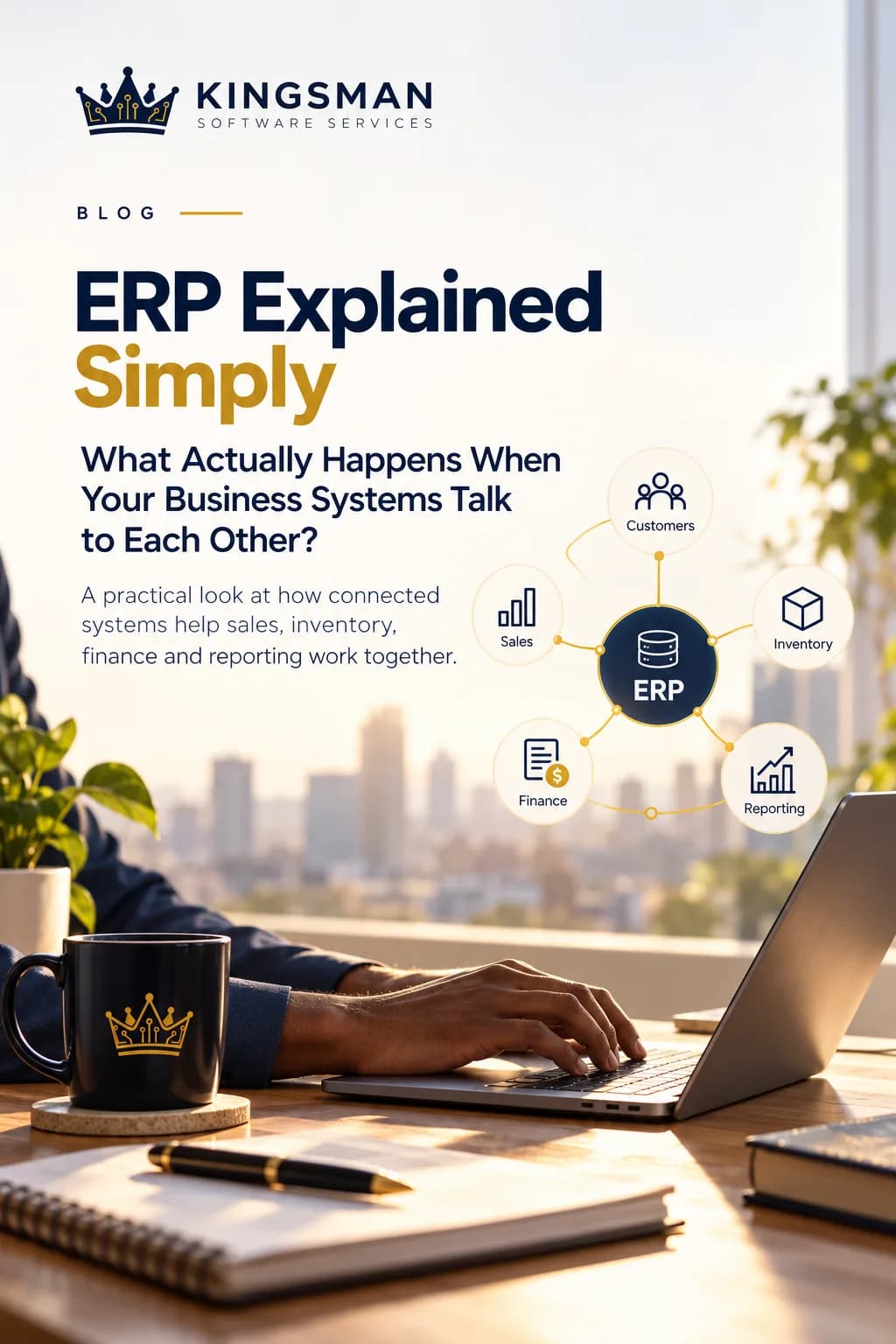
Good software should help systems communicate.
APIs and integrations can allow information to move automatically between platforms, reducing duplicated work and human error.
For example, a business transaction could automatically update:
inventory
financial records
customer history
management reports
Instead of employees entering the same information into four separate systems.
Software Should Grow With the Business
Businesses change.
A system built today should anticipate that tomorrow the organisation may have more customers, employees, branches, devices, transactions, or services.
Scalable software architecture makes it possible to expand without rebuilding everything from the beginning.
This becomes particularly important for distributed applications where multiple users and devices interact with shared information simultaneously.
Technologies such as cloud infrastructure, containerisation, distributed databases, caching, message queues, and asynchronous processing can help applications scale while remaining reliable.
The goal, however, should never be complexity for its own sake.
Architecture should be appropriate for the problem being solved.
Building Technology Around Real Problems
The most successful software projects often begin with a simple question:
What problem are we actually trying to solve?
Technology should not be introduced simply because it is fashionable.
Artificial intelligence, cloud computing, mobile applications, automation, and other technologies are valuable when they solve measurable business problems.
That could mean:
reducing manual data entry
improving customer service
making reports available faster
reducing operational costs
improving communication
automating repetitive tasks
giving management better visibility
enabling employees to work remotely
improving reliability across multiple locations
The technology is the tool.
The business problem should always come first.
The Opportunity for Zimbabwean Businesses
Zimbabwe has a growing community of entrepreneurs, developers, startups, SMEs, NGOs, institutions, and established companies looking for better ways to operate.
There is significant opportunity to build digital solutions specifically designed around these organisations.
Instead of simply importing technology, we can also build systems locally, customise proven open-source platforms, create integrations, and develop software that responds directly to the challenges businesses encounter every day.
That is the kind of technology ecosystem we want to contribute to at Kingsman Software Services.
Our focus is simple:
Understand the problem. Design the right solution. Build technology that works in the real world.
Comments (2)
This is a very relevant perspective. Too often, businesses adopt software designed for completely different environments and then struggle to make it fit their operations. Building around local realities like connectivity, payments, mobile access and scalability can make a huge difference. Great read.
Good read, thank you
Leave a comment